On Frantz Fanon and the Manichean World
Samia Henni
Originally published in Mousse 87
April 2024
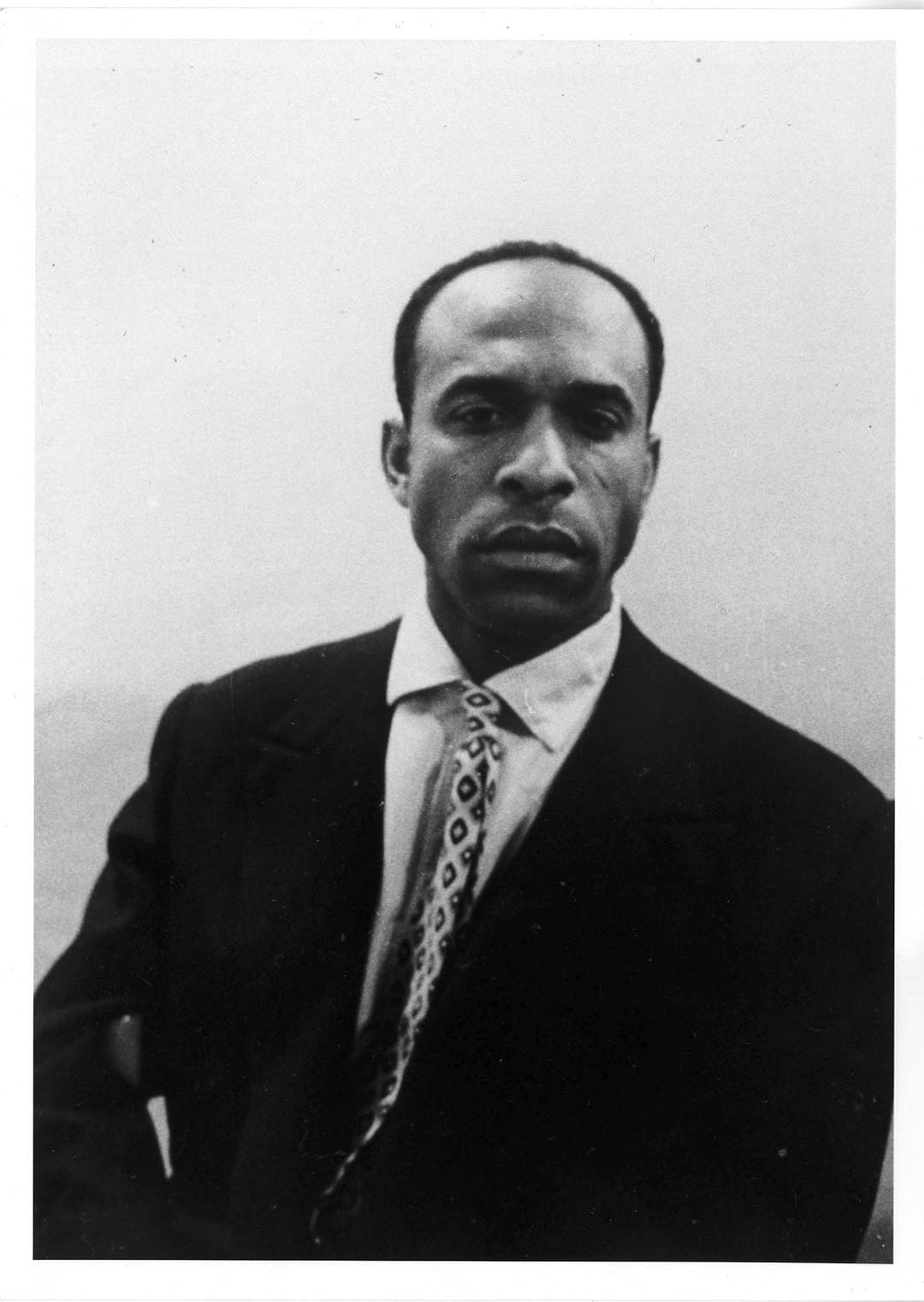
Frantz Omar Fanon (1925–1961), the psychiatrist, political philosopher, and anti-colonial activist from the French colony of Martinique (today a French department), played an essential role in treating and theorizing the psychological agony of French colonial rule in Algeria, where I was born and raised through age eighteen. As I wrote about in Architecture of Counterrevolution: The French Army in Northern Algeria (2017), Fanon’s work is inspirational for its investigation of what he called, in his 1951 rejected medical dissertation at the University of Lyon, the “psychology of colonialism.” His dissertation was published as a book in 1952, when Fanon was twenty-seven, under the title Peau noire, masques blancs (Black Skin, White Masks) by Éditions du Seuil.1 His theories were further refined when he experienced French colonial conditions firsthand in Algeria between 1953 and 1956. The resulting works included L’an V de la révolution algérienne (A Dying Colonialism, 1959), Les Damnés de la terre (The Wretched of the Earth, 1961), and Pour la révolution africaine (Toward the African Revolution, posthumously issued in 1964). He also published numerous articles in academic journals and anti-colonial newspapers, such as the Algerian El Moudjahid, whether as a practicing psychiatrist, as the ambassador to Ghana for the Algerian provisional government, as an anti-colonial activist at conferences across Africa, or as a member of the Algerian Front de la libération nationale (FLN) during the Algerian Revolution (1954–62). The 2015 publication of his unpublished writings, Écrits sur l’aliénation et la liberté (Alienation and Freedom), completed Fanon’s anti-colonial engagements.2 I cannot write this without keeping in mind the ongoing war on Gaza and the Manichean order that it exposed.
Fanon began his position as a psychiatrist at Blida-Joinville psychiatric hospital (which today bears his name), about forty-five kilometers southwest of Algiers, in November 1953, one year before the onset of the Algerian Revolution.3 This was a bloody armed conflict between the French colonial regime, whose occupation of Algeria had begun in 1830, and the Algerian liberation fighters and their national and international supporters. The war lasted nearly eight years, during which destruction, forced displacement, incarceration, torture, rape, and other forms of violence and alienation were normalized.4 Upon his arrival, Fanon was charged with reforming the two wards newly under his responsibility.
The colonial psychiatric hospital of Blida-Joinville was enormous and overcrowded. It was designed to host 1,200 beds, but in 1953, it held 2,500.5 It separated patients along racial lines—European versus Algerians, the latter called musulmans (Muslims)—as well as gender lines. Of Fanon’s two wards, one housed 168 European chronic and senile women patients, and another, a little over a kilometer away, 225 Algerian men in a ward of epileptics and another ward housing 168 chronic patients.6 During the fight for independence, Fanon began treating incoming Algerian patients who had been subjugated to heavy torture.
In December 1956, after three years of extensive work in colonized Algeria, Fanon resigned from his position, as it was clear to him that it was precisely the French colonial regime that was producing and maintaining the mental distress he was tasked with ameliorating. He understood that it was not possible to cure colonial alienation without liberation and independence from colonial domination. For Fanon, “the colonial world is a Manichean world,”7 a world marked by violence, segregation, exploitation, dispossession, censorship, lies, injustice, and destruction. Fanon’s letter of resignation, submitted to Robert Lacoste, the French resident minister and governor general of colonized Algeria, articulated his refusal to continue participating in the colonial project of “dehumanization” of Algerians:
“For nearly three years, I put myself wholly at the service of this country and the people who inhabit it. I have spared neither my efforts nor my enthusiasm. There is not an ounce of my activity that has not demanded as its horizon the unanimously desired emergence of an acceptable world.
But what are a man’s enthusiasm and care if daily reality is woven with lies, acts of cowardice and scorn for humankind? What are intentions if their embodiment is made impossible by an indigence of heart, sterility of spirit and hatred for this country’s natives? Madness is one of the ways that humans have of losing their freedom. And I can say that, placed at this junction, I have measured with terror the extent
of the alienation of this country’s inhabitants.
If psychiatry is the medical technique that sets out to enable individuals no longer to be foreign to their environment, I owe it to myself to state that the Arab, permanently alienated in his own country, lives in a state of absolute depersonalization.
What is the status of Algeria? A systematic dehumanization. Now, the absurd wager was to want at whatever price to ensure the existence of some values whereas lawlessness, inequality, and multiple daily murder of humanness were erected as legislative principles. The extant social structure in Algeria stood opposed to any attempt to put the individual back in his or her place.
Monsieur le Ministre, there comes a time when tenacity becomes morbid perseveration. Hope is then no longer the open door onto the future, but the illogical maintenance of a subjective attitude in a systematic break with reality.
Monsieur le Ministre, to the observer’s eyes, the current troubles and bloodshed in Algeria do not constitute a scandal. This is neither an accident nor a breakdown in the mechanism. The troubles in Algeria are the logical consequence of an abortive attempt to decerebralize a people.
It was hardly necessary to be a psychologist to divine that under the apparent affability of the Algerian, behind his bare humility, there lies a fundamental demand for dignity. And nothing is to be gained, upon the occasion of demonstrations that could not be plainer, by appealing to some sort of civic-mindedness.
The function of a social structure is to set up institutions that are traversed by a concern for humankind. A society that forces its members into desperate solutions is a non-viable society, a society that needs replacing. The citizen’s duty is to say so. No professional morality, no class solidarity, no desire to refrain from washing the dirty laundry in public, can have a prior claim. No pseudo-national mystification finds grace when up against the demand to think.
[. . .]
For long months, my conscience has been the seat of unpardonable debates. And their conclusion is the will not to lose hope in man, that is to say in myself. My decision is not to bear a responsibility, at whatever cost, on the false pretext that nothing else is to be done.”8
Fanon’s description of colonial atrocities persisted after this, and continued to be stressed in both his literary works and his medical analyses of the violence that the Manichaean realm generated. He argued that “it is not enough for the settler to delimit physically, that is to say with the help of the army and the police force, the place of the native. As if to show the totalitarian character of colonial exploitation, the settler paints the native as a sort of quintessence of evil.”9Fanon’s insistence on language and imposed categories highlights the working mechanics of a constructed system of judgments and projections. Being concerned with analysis and critique of the psychology and psychopathology of colonialism, dispossession, oppression, and violence, he attempted to unpack and report on colonial protocols and doctrines, which he himself experienced in colonized Martinique, France, and colonized Algeria. In doing so, he crafted the ethical quintessence of anti-colonial practices as a commitment to human dignity, accountability, liberation, and justice.
For Fanon, violence is both a human (political) and a medical (scientific) notion. He identified at least three categories—offensive colonial violence, defensive anti-colonial violence, and violence in the international context—opening up possibilities for constructive reconsiderations of world orders, spaces, and assumptions. His ambition was to scrutinize the “them versus us,” or “the other versus the self” dichotomies of both the colonial world and the Cold War—including the threat of nuclear war—and to map nuances that the colonizer might have consciously or unconsciously censored, distorted, or obliterated.10 His pathology (political and scientific) of colonial ideologies and anti-colonial struggles agitated for pluri-directional and multi-scalar approaches to human practices and solidarities.
The division between “self” and “other,” as well as the representation of the “other,” is a human construct.11 It is contingent on the person or institution that establishes, evaluates, judges, and qualifies another person or space in relation to the self, the norm, the normative. Colonial regimes have propagated these constructs and disseminated their misconceptions among European and North American populations since the beginning of the first wave of colonization and the transatlantic slave trade. Furthermore, the production of colonial spaces entails the destruction of existing spaces, and the imposition of new norms of breathing, eating, living, commuting, governing, and building.12 Whether they are called the “civilizing mission” in the context of colonization, or “development” and “investment” in today’s context of globalization, these colonial operations reinforce a particular world (dis)order.13 As Fanon argued, the primary encounter between colonizers and colonized was marked by violence: “Their first encounter was marked by violence and their existence together—that is to say the exploitation of the native by the settler—was carried on by dint of a great array of bayonets and cannons. . . . Violence in its practice is totalizing and national. As a result, it harbors in its depths the elimination of regionalism and tribalism.”14
Examples of this elimination can be found in geographies across Africa, Asia, Australia, the Americas, and the Middle East. These are places in which a harsh extermination of Native people occurred, and continues to occur, along with the destruction of their habitat and the imposition of imported forms, norms, and construction materials from England, France, Germany, Italy, the Netherlands, Portugal, Spain, and other such countries. In analyzing the exclusionary relationship between the colonizer and the colonized, Fanon argued that “no conciliation is possible, for of the two terms, one is superfluous.”15 This impossibility of conciliation is shown in the various forms of annihilating and killing people, and how built and natural environments have been destroyed and contaminated. These forms are integral parts of the colonial world.
Fanon’s critique of the Manichean world, his refusal “to bear a responsibility, at whatever cost, on the false pretext that nothing else is to be done” as well as his determination “not to lose hope” in humanity, provide an ethic of anti-colonial reason. They incite reflection on the ongoing cate-gories and cartographies of the so-called postcolonial, international, and global, which often echo the colonial world order of dispossession, including the extraction, exploitation, and transportation of capital and resources.16 This tendency should be challenged together with such widely used taxonomies as “war,” “peace,” “pacification,” “genocide,” “urbicide,” “ecocide,” and others, which also belong to the Manichaean world order that Fanon meticulously analyzed and critiqued.
Fanon’s enduring arguments expose the existing war operations and violent spatial, social, and environmental conditions that governments and institutions have generated and/or are tolerating. These situations are to be understood transnationally, connecting the construction of colonial spaces and places by colonizing regimes with the construction and destruction of spaces in formerly or currently colonized places. Such multidirectional and multi-scaled approaches are informed by anti-colonial, abolitionist, Indigenous, and other traditions of associating anti-colonial and decolonial practices with aspirations for national liberation and social, spatial, and environmental justice. Yet, as Fanon argued, “Whatever may be the headings used or the new formulas introduced, decolonization is always a violent phenomenon.”17That violence is both political and scientific.
- Samia Henni, Architecture of Counterrevolution: The French Army in Northern Algeria (Zurich: gta Verlag, 2017). On the rejection of Frantz Fanon’s dissertation, see, for example, Alice Cherki, Frantz Fanon: Portrait (Paris: Éditions du Seuil, 2000), 39.↑
- Fanon has been criticized regarding his takes on women’s and feminist’ liberation. For a nuanced analysis of the contexts of this criticism, see, for example, Sharpley-Whiting, T. D., Frantz Fanon: Conflicts & Feminisms (Oxford: Rowman & Littlefield Publishers, 1998).↑
- Before joining this hospital, Fanon worked at the psychiatric hospital of Saint-Alban-sur-Limagnole in France’s Massif Central. One of his mentors was François Tosquelles, who was both a psychiatrist and a resistance fighter. Tosquelles pioneered social therapy, also known as in- stitutional psychotherapy.↑
- On the use of violence during the Algerian War of Independence, see for example Jean-Luc Einaudi, La ferme améziane: Enquête sur un centre de torture pendant la guerre d’Algérie (Paris: L’Harmattan, 1991); Pierre Vidal-Naquet, Les crimes de l’armée française: Algérie 1954–1962 (Paris: Editions La Découverte, 2001); Pierre Vidal-Naquet, Torture: Cancer of Democracy, France and Algeria, 1954–62, trans. Barry Richard (Baltimore: Penguin Books, 1963); Raphaëlle Branche, La torture et l’armée pendant la guerre d’Algérie: 1954–1962 (Paris: Editions Gallimard, 2001).↑
- Frantz Fanon, Alienation and Freedom, ed. Jean Khalfa and Robert J. C. Young, trans. Steve Corcoran (London: Bloomsbury Academic, 2018), 349.↑
- Fanon, Alienation and Freedom, 349.↑
- Frantz Fanon, The Wretched of the Earth (New York: Grove Press, 1963), 41.↑
- Fanon, Alienation and Freedom, 433–35.↑
- Fanon, The Wretched of the Earth, 41.↑
- On Fanon’s definitions of violence, see “Concerning Violence” and “Violence in the International Context” in Fanon, The Wretched of the Earth, 35–106. Fanon’s approach to violence and its effects was informed by the violence of the colonial world that he experienced and attempted to cure. Sometimes his work has been taken out of context, and he was unfairly accused of inciting violence. But Fanon argued that violence is the natural state of colonial rule, and that the colonial space is maintained through violence.↑
- See, for example, Frantz Fanon, Black Skin, White Masks (New York: Grove Press, 1967); Edward W. Said, Orientalism (London: Routledge and Kegan Paul, 1978); Athena Athanasiou and Judith Butler, Dispossession: The Performative in the Political (Cambridge, UK: Polity, 2013); Achille Mbembe, Critique of Black Reason, John Hope Franklin Center Books (Durham, NC: Duke University Press, 2017); Walter Mignolo, Local Histories/Global Designs: Coloniality, Subaltern Knowledges, and Border Thinking (Princeton, NJ: Princeton University Press, 2012).↑
- See, for example, Paul Rabinow, French Modern: Norms and Forms of the Social Environment (Chicago: University of Chicago Press, 1989); Nezar AlSayyad, Forms of Dominance: On the Architecture and Urbanism of the Colonial Enterprise (Aldershot, UK: Avebury, 1992); Eyal Weizman, Hollow Land: Israel’s Architecture of Occupation (London and New York: Verso, 2007); Itohan Osayimwese, Colonialism and Modern Architecture in Germany: Culture, Politics, and the Built Environment (Pittsburgh: University of Pittsburgh Press, 2017); Henni, Archi- tecture of Counterrevolution.↑
- See, for example, Samia Henni, “The Colonial Order of Things,” in Archithese Reader: Critical Positions in Search of Postmodernity, 1971–1976, ed. Gabrielle Schaad and Torsten Lange (Zurich: Triest Verlag für Architektur, 2024), 389–403; Samia Henni, “Colonial Ramifications,” e-flux Architecture, October 31, 2018, https://www.e-flux.com/architecture/history-theory/225180/colonial-ramifications/.↑
- Fanon, The Wretched of the Earth, 36, 51.↑
- Fanon, The Wretched of the Earth, 39.↑
- See for example Arjun Appadurai, Modernity at Large: Cultural Dimensions of Globalization, vol. 1, Public Worlds (Minneapolis: University of Minnesota Press, 2010); Samia Henni, “Anticolonial Remedies: From Colonization to Globalization,” Perspecta 53(2020): 193–203; Walter Mignolo, Globalization and the Decolonial Option (London: Routledge, 2010).↑
- Fanon, The Wretched of the Earth, 35.↑